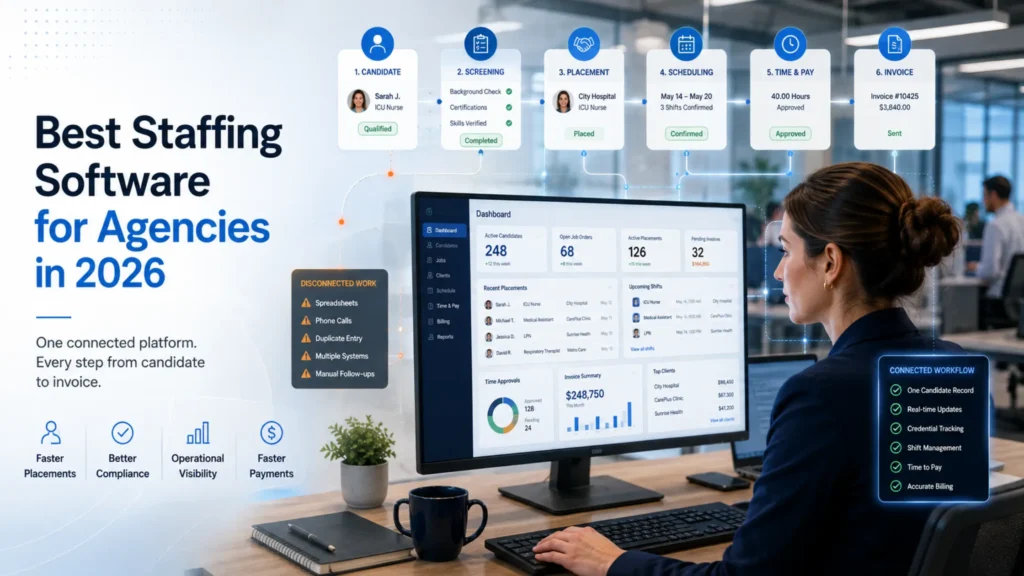
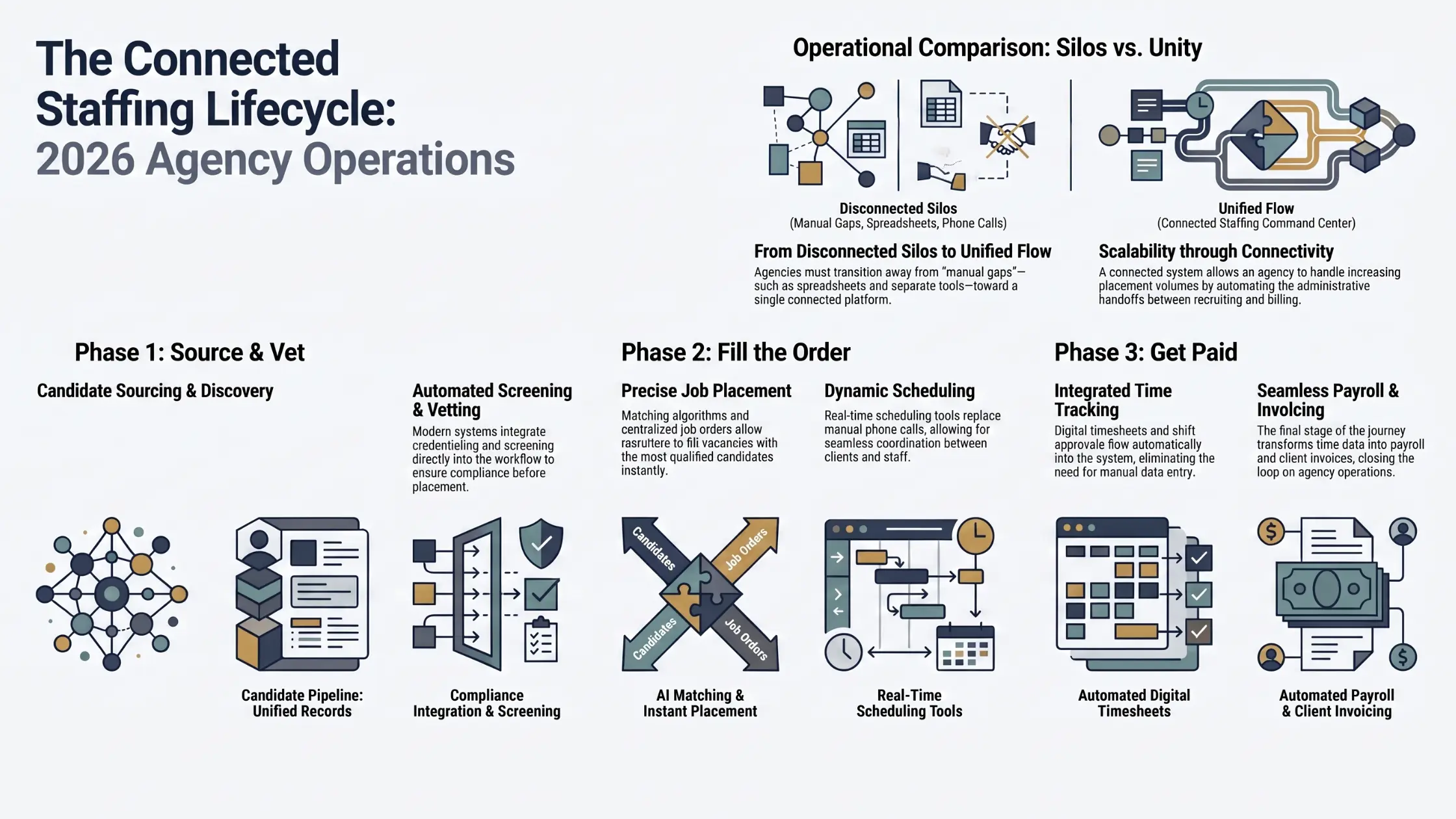
Staffing agencies live and die by three operational speeds: how fast you source and vet candidates, how fast you fill an order, and how fast you get paid for the placement. The software underneath those three speeds matters more than most agencies budget time to evaluate properly. Here’s a practical comparison of seven platforms built for agency operations.
What should agency owners actually evaluate?
Skip the generic features list and map your own workflow first: application to screening, screening to placement, placement to invoice. Every manual handoff in that map, a spreadsheet, a phone call, a re-typed field, is where a purpose-built platform should remove work. The platform that wins isn’t the one with the most features. It’s the one that closes the most gaps in your specific workflow.
Quick comparison: how the 7 platforms differ
| Platform | Best for | Front-office strength | Back-office / billing |
| Vars Health | Healthcare agencies wanting one connected system | Healthcare-specific ATS | Native, facility-level rate config |
| TempWorks | Multi-vertical agencies | Combined ATS/CRM | Native Pay/Bill |
| Crelate | Boutique agencies wanting recruiting speed | AI-assisted sourcing | External integrations |
| AkkenCloud | Mid-size agencies wanting configurability | Configurable ATS/CRM | Integration-based |
| JobDiva | Mid-market agencies wanting CRM depth | Enterprise CRM, Healthcare Wallet | VMS synchronization |
| Ceipal | Agencies wanting a unified staffing OS | AI-assisted matching | Modular |
| Avionté (BOLD) | Agencies wanting recruiting + payroll in one | Unified CRM/ATS | Native payroll |
1. Vars Health
Vars Health treats credentialing as the core data structure rather than a bolt-on feature, which matters for agencies where an uncredentialed placement is a compliance risk, not simply a bad match. Candidates move through a healthcare-specific ATS, with automated credential expiration tracking configurable per facility, self-service scheduling and shift acceptance, integrated payroll and billing with facility-level rate configuration, and a white-labeled mobile app agencies publish under their own brand.
It’s built agency-first, with hospital-side modules for float pool management and VMS automation available but not the platform’s core focus. Best fit: agencies wanting credentialing and operations to run through one connected record instead of reconciling separate systems.
2. TempWorks
TempWorks has more than two decades in staffing technology behind it, with ATS, CRM, and Pay/Bill functioning as one connected system rather than separate tools. A combined ATS and CRM for job order and client management, integrated payroll and billing, the TempWorks Buzz mobile app with geofenced time and attendance, and business intelligence reporting across recruiting and financial data round out the platform.
TempWorks spans multiple staffing verticals rather than specializing in one, a strength for multi-vertical agencies and a lesser fit for agencies wanting deep single-vertical specialization. It suits agencies wanting one system covering healthcare plus other industries.
3. Crelate
Crelate is a recruiting CRM and ATS with strong AI-assisted sourcing and drag-and-drop pipeline automation, plus healthcare-specific credentialing tied to role and facility requirements. A client portal for real-time hiring manager communication and add-on modules extending into onboarding and contractor time tracking fill out the platform.
Crelate’s core strength is front-office recruiting speed. Agencies with complex, multi-rate invoicing needs should confirm Crelate’s external payroll and HCM integrations cover their billing model, since it connects to outside providers rather than replacing them. Best fit: agencies prioritizing recruiter speed and candidate experience who are comfortable connecting an external back office.
4. AkkenCloud
AkkenCloud serves multiple staffing verticals with configurable front, middle, and back office in one platform. Integrated ATS and CRM with job order management, credential documentation tracking with expiration monitoring, an employer portal for client visibility, and payroll and billing integration with mobile access make up the core feature set, alongside real-time reporting and web-based scheduling calendars built for shift and emergency fills.
Configuration flexibility is a strength here, but that same flexibility means more setup decisions upfront. Budget time for configuration rather than expecting an out-of-the-box fit. Mid-size agencies wanting front-to-back-office consolidation they can shape to a specific workflow are the best fit.
5. JobDiva
JobDiva combines full ATS, CRM, and VMS synchronization with a distinctive healthcare feature: the Healthcare Wallet, a portable credential record candidates carry across assignments. More than 100 integrations, an open API suite, mobile apps for recruiters and candidates including white-label options, and staffing-specific reporting and BI dashboards round out the platform.
Reviewer scores run strong, but the workflow is known for spreading across multiple browser tabs, which can steepen the learning curve for smaller teams. Best fit: mid-market agencies wanting deep CRM functionality and credential portability across assignments.
6. Ceipal
Ceipal’s pitch is a unified staffing OS combining ATS, VMS, AI-assisted sourcing, and workforce management under one roof, reducing tool-switching by connecting sourcing, matching, vendor management, and workforce administration into shared modules. It serves both agencies and internal healthcare staffing programs.
The platform’s breadth means evaluating whether you need the full module set, and pricing isn’t publicly disclosed, so plan on a quote-based conversation rather than a fixed number upfront. It fits agencies wanting one connected platform across ATS, VMS, and workforce management.
7. Avionté (AviontéBOLD)
AviontéBOLD is built front-to-back, with native payroll and billing rather than a separate vendor bolted on. Unified CRM and ATS, credentialing and compliance tracking, and an open API program for third-party integrations round out the platform, all under one system of record.
The tight front-to-back integration is the clearest differentiator, but agencies with an existing payroll vendor should confirm compatibility before switching, since the platform assumes payroll runs natively rather than alongside an outside provider. Best fit: agencies wanting recruiting and back-office operations running through one system rather than integrated separately.
What actually separates a good fit from a bad one
Most agencies default to comparing feature lists side by side, which tends to favor whichever platform has the longest list rather than the one that fits. A shorter, more useful comparison looks at three things: how the platform handles the one workflow that currently causes the most manual work, how much configuration is required before it’s usable day to day, and what happens when your agency’s volume doubles.
That third question gets skipped more than it should. A platform that works well at twenty placements a month can behave very differently at two hundred, particularly around credentialing renewal volume and billing complexity across more facilities and rate structures. Ask any vendor directly how their platform’s performance and support model change as agency volume scales.
How to choose
Map your workflow from application to invoice before you take a single demo. Every point where something falls through, gets manually re-entered, or requires a phone call to confirm is a gap the right platform should close. Agencies that skip this step tend to buy based on a demo’s polish rather than actual fit, then end up patching gaps with the same manual processes they were trying to escape.
Frequently asked questions
1. What is the difference between an applicant tracking system and full staffing agency software?
An ATS manages the candidate pipeline: sourcing, screening, and tracking applicants. Full staffing agency software adds scheduling, payroll, billing, and often credentialing, covering the complete cycle from placement to invoice rather than just the hiring funnel.
2. How much does staffing agency software cost for a small or mid-size agency?
Pricing is usually quote-based and scales with agency size, module count, and user seats. Expect a custom quote rather than fixed public pricing beyond entry-level plans.
3. How long does it take to implement new staffing software for a growing agency?
Turnkey platforms can go live in a few weeks. Enterprise platforms with deeper configuration needs typically take longer, sometimes a couple of months, depending on integration scope.
4. Is it worth switching staffing software if our current system mostly works?
Only if specific, recurring problems justify it: credentialing errors, billing inaccuracies, or recruiters relying on personal spreadsheets because the system can’t track what they need. A migration costs real time, so confirm the gap is worth closing before committing.
5. Can small staffing agencies benefit from the same software as large enterprise firms?
Often, yes, but the fit differs. Smaller agencies typically do better with turnkey platforms built for fast go-live, while larger agencies with dedicated ops and IT support can extract more value from deeply configurable enterprise systems.